DIU Hosts Bangladesh's First Decolonising Law and Criminology Conference
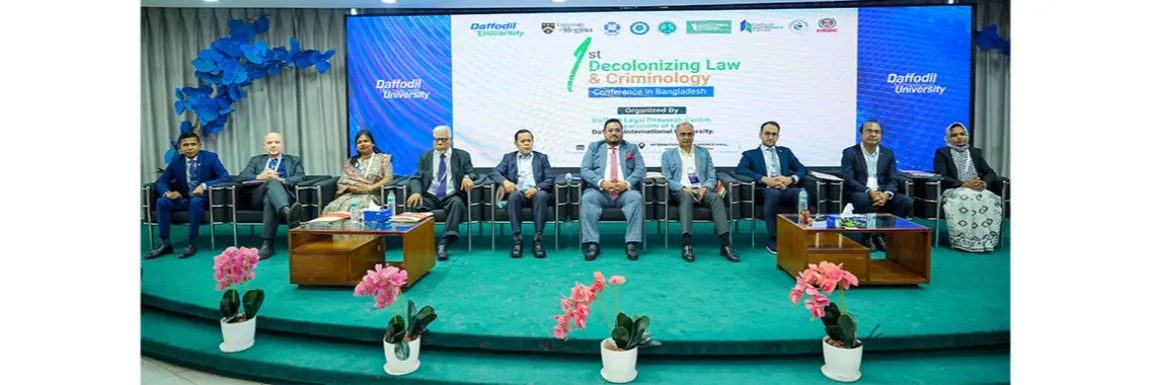
DIU Hosts Bangladesh's First Decolonising Law and Criminology Conference
Bangladesh's first international conference on Decolonising Law and Criminology was held at Daffodil International University (DIU) on Sunday, 2 August, bringing together legal scholars, judges, policymakers, researchers, lawyers, and students to critically examine law, criminology, and the justice system beyond colonial frameworks. Organized by the Department of Law, Daffodil Legal Research Center (DLRC), and several national and international academic institutions, the conference was held under the theme "Unshackling the Mind: Decolonising Law, Criminology and Justice in Bangladesh."
The conference marked the first initiative of its kind in Bangladesh to focus on the colonial legacy in law, criminology, and the justice system while promoting discussions on indigenous knowledge, justice, and alternative legal approaches. The event provided a platform for academics and legal professionals from Bangladesh and abroad to exchange research, ideas, and experiences on contemporary legal and judicial issues.
The event was attended by Barrister Mir Mohammad Helal Uddin, State Minister for Land and Chattogram Hill Tracts Affairs, as the guest of honour. Professor Dr. Md. Sabur Khan, Chairman of the Board of Trustees of Daffodil International University, attended as the chief guest, while Dragan Popovic, Senior Programme Adviser (Governance) at UNDP Bangladesh, joined as the special guest.
Distinguished guests included Justice M. A. Matin, former Judge of the Appellate Division of the Supreme Court of Bangladesh, and Justice Zinat Ara, Chairman of the Bangladesh Law Commission.
The conference also featured presentations and research papers by Syeda Shazia Sharmin, Deputy Attorney General of Bangladesh; Barrister Ragib Rauf Chowdhury, Chairman of the Legal Education Committee of the Bangladesh Bar Council; Professor Dr. Selcuk Aydin of Boğaziçi University, Türkiye; Professor Dr. Liza Sharmin, Dean of the Faculty of Humanities and Social Sciences at DIU; Professor Dr. Kudrat-E-Khuda Babu, Associate Dean of the Department of Law at DIU; Professor Dr. Md. Robiul Islam, Dean of the Faculty of Law at Jahangirnagar University; Ram Tiwari, Executive Director of the Nepal Forum for Restorative Justice; Associate Professor Dr. S. M. Saiful Haque, Head of the Department of Law at DIU; and Professor Dr. Muhammad Asadullah, Director of the Daffodil Legal Research Center (DLRC) and Visiting Professor, along with researchers from universities and institutions in Bangladesh and abroad.
The academic sessions featured paper presentations and panel discussions under four major themes: Indigenous Justice Systems, The Impact of Colonialism on Bangladesh's Justice System, Decolonising Security and Counter-Terrorism, and Transitional Justice and Criminology. The discussions explored post-colonial legal frameworks, indigenous knowledge systems, alternative approaches to legal practice, and strategies for promoting equitable and inclusive justice.
Addressing the conference, Barrister Mir Mohammad Helal Uddin, State Minister for Land and Chattogram Hill Tracts Affairs, said, Through necessary reforms, we want to strengthen our institutions, ensure the protection of human rights, and make Parliament more effective and vibrant in building a more just and inclusive society.
Speaking at the conference, Barrister Ragib Rauf Chowdhury, Chairman of the Legal Education Committee of the Bangladesh Bar Council, said, our diverse culture and social realities call for rethinking conventional approaches to land distribution and management. We need legal frameworks that recognize local perspectives and are better aligned with the realities and needs of our people.
The organizers said the conference has created a valuable platform for advancing research in law and criminology, strengthening international academic collaboration, and promoting new perspectives on justice. They expressed hope that the initiative would contribute to future research, policy dialogue, and legal reforms on post-colonial law and the justice system in the context of Bangladesh.